
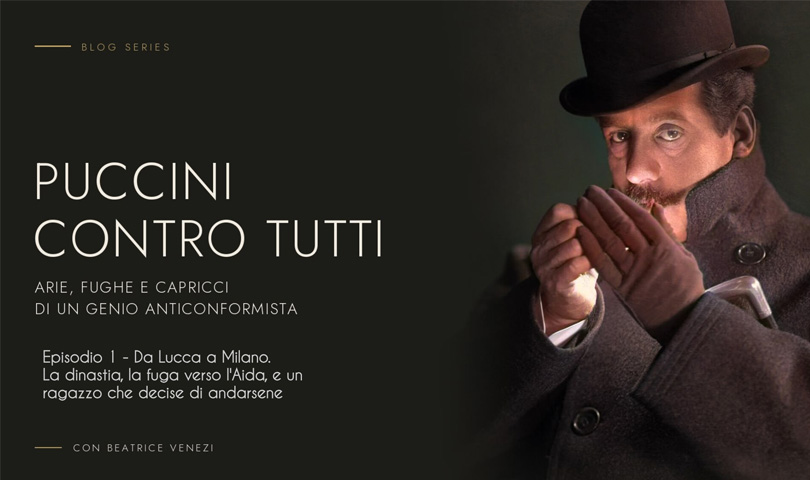
BEATRICE VENEZI'S BLOG. From Lucca to Milan. The dynasty, the flight to Aida, and a boy who decided to leave –
With this new cycle, I return to Giacomo Puccini, to whom in 2024, on the occasion of the centenary of his death, I dedicated Puccini against everyone. And I’m doing this now because we’re approaching Puccini’s month: the one that runs from November 29, the anniversary of his death in Brussels in 1924, to December 22, the day he was born in Lucca in 1858. A whole month to spend with him. Let’s start at the beginning.
I want to start with a night in 1876, and with three boys walking along.
My name is Giacomo and I have two friends, Carlo Carignani and Gigi Pieri. For days they have been training really hard, in the evenings, grinding out rounds around the center of Lucca: one round, two rounds, three rounds, then the run to the Santa Maria Forisportam column, with a half-smoked Tuscan cigar in hand. It’s not just a game in itself. Because Giacomo had an idea, and he proposed it to the other two with the naturalness of someone who doesn’t reject a no:
«Next week in Pisa there is the Aida. Should we go there?»
In Pisa, not in Lucca. Twenty kilometers one way and twenty back. On foot, because there is no money for anything else. And in front of the doubts of Carignani, the most hesitant of the three, Puccini already reacts like Puccini, with a scathing remark:
«Or that you don’t have legs like me and Saint Francis when he was saddling his horse?»
That boy is seventeen years old, his black hair combed back, barely a hint of a mustache on his lip. He arrives in Pisa exhausted, hungry. But the real obstacle, they discover, is not the road: it’s that they have neither the tickets nor the money to buy them. If it weren’t for the theater usher, who is won over by so much stubbornness and lets them through, they would never have entered that night. All of us today have a small debt of gratitude towards that usher. Because it is inside there, in front of Verdi’s Aida, that something in Giacomo is ignited forever. Not the sacred music of his city, but the theater, the melodrama, the whole world. His first biographer, the librettist Giuseppe Adami, tells it like this:
«A wave of poetry enveloped him and carried him into an increasingly higher, increasingly distant, unreal atmosphere. […] Verdi seemed to him a powerful and protective God who looked down on him from above, and merciful, with his sacred hand, he opened the bronze doors of an endless road.»
On their return, the three walk in silence, so as not to waste what they have inside. And when Giacomo returns home to find the sun already rising, he finds his mother staring out the window. «Have you returned?», he asks softly, so as not to wake the family. He nods in agreement, climbs the stairs, and murmurs something between them that is already a prophecy: «Yes, but for a little while longer».
He was right. But to understand why that boy was so sure to leave, we need to know two things: his blood and his mother.
The blood first. Because Puccini, even before being a genius, is the last link in a chain. He breathed music from birth, as if it were air. His great-grandfather Giacomo was a musician, the maestro of the Palatine Chapel of the Republic of Lucca. His great-grandfather, grandfather, and father Michele were organists of the cathedral. Five generations, one after the other. The Puccinis were the chapel masters of the city; they were the ones who, from father to son, were responsible for the sacred music of the Duomo: a hereditary profession, almost a noble title for sound. And when Michele died in 1864, the city assumed that that five-year-old child would one day take his place. It was all already written. His destiny, as for the characters in the works he would later compose, seemed decided even before he could speak.
And then there is her: Albina Magi, the mother. It is she who is the true protagonist of this first part of the story. Left a young widow, alone with nine children, seven girls and two boys, without means, Albina never gives up. And on Giacomo, in particular, she pours a fierce and lucid ambition. She understands before anyone else that that son has a different talent. She makes him study singing and violin from childhood, sends him to the Pacini Music Institute, and dreams for him the place that had been her father’s: organist of the Cathedral of San Martino.
Only that dream, curiously enough, does not come true. Giacomo applies, is supported by half the city, and is rejected. Too young, they say; too restless and stubborn, whispers someone else. Albina tries again three years later, and again nothing. It is one of the first ironies of this life: the family position, what seemed written in destiny, Puccini will never have it. Because his destiny, simply, was another.
The first true triumph comes, however, by a different route. On April 29, 1877, at the age of eighteen, Giacomo presented his Motet to Saint Paulinus, the patron saint of Lucca, to the city’s music institute. «Praise the people of Lucensi who stood up against them», Give a round of applause, people of Lucca, for your bishop. And on July 12, the feast of the saint, the Mottetto resounds in the church. Adami writes: «If he hadn’t been in church, there would have been big applause at the end». A triumph. For days, in the city, no one talks about anything else.
On the surface, he seems to be the kind of guy who does what you would expect of him: sacred music, city-based, traditional. But the most interesting thing is what is already present in that youthful music. Because it’s not just a high school composition: it dramatizes the liturgical text, brings it closer to the ear of the listener, even incorporating elements that recall the waltz within a sacred composition. In short, there’s already all the Puccini we’ll love: the obsession with making the music heard, giving it flesh, warmth, and human movement. Aida, of course, had already made its mark.
That success also has the flavor of a vindication. Because in that same 1877 Giacomo had suffered a scathing rejection in a city competition, with a jury that advised him, in an humiliating way, to«to go back to studying». A blow that could have extinguished a boy. Not him. To the distraught mother he replied with a phrase that says everything about his character: «Oh mom, don't confuse them. I will soon prove that they are pigs».
But after the Mottetto, Lucca begins to get close to him. The path that seemed written, the choirmaster, the sixth generation, crumbled that night in Pisa. Giacomo looks far ahead: to Milan, to the conservatory, to the great world of music. And when he talks about it with his cousin and mentor Cerù, who objects that one thing is to desire and another is to succeed, especially without money, Giacomo answers with an ambitious and disarming phrase at the same time. In Lucca, money is called bigei:
«It’s to make some big bucks that I would like to leave… Or that didn’t leave Lucca in the hundreds, in the thousands, those figuremakers who made their fortune in America and have returned, some of them, as well-off, well-off people who have bought the most beautiful villas in the area?»
It's not arrogance. He's a provincial boy who understood, before anyone else, that his talent does not belong to the city in which he was born.
The problem, however, remains enormous: studying in Milan costs a sum that neither Albina nor her guardian can afford. And here Albina plays the most daring card of all. She writes to the queen. Yes, to Queen Margherita, «always ready to protect artists». A provincial widow who writes to the queen of Italy for the future of her son: it is the same stubborn courage that the son will put into every one of his works shortly thereafter. She is so sure of it that she tells Giacomo about the plan with determination that moves her:
«If the Queen grants the allowance, you can leave and may God protect you. As for me, I am ready to sacrifice losing you, if that is your good.»
And he succeeds. Within just two weeks, the widow Puccini actually obtains a pension from the queen: one hundred lire a month for a year, so that her son can study in Milan. The highest official recognition possible, for a boy from the countryside.
Giacomo leaves in the autumn of 1880. He leaves behind Lucca, the hundred churches and the hundred towers, the court house of San Lorenzo, and a mother who knows she is losing him, who knows that she will never again be the maestro di cappella, and who has just given up on him so that he can become himself. In front of him is Milan: the most modern city in Italy, the first electric lights, the first horse-drawn trams, the theaters, the salons. And an entire world to conquer.
But what happened in Milan, the real bohème, the one made of hunger and minestrone soup, the first work, the first failures and the first true triumph, is another story. I’ll tell you about it next time.
For now, just keep in mind the image of those three boys walking through the night towards Pisa to hear Verdi. A boy who, instead of inheriting a pre-determined destiny, decides to walk forty kilometers to get his own. Puccini, after all, did exactly the same for his entire life. And they will call him, not by chance, an unconventionalist.
Beatrice Venezi