
Beatrice Venezi's BLOG –
History, wrote Karl Marx, always repeats itself twice: the first as a tragedy, the second as a farce. But on closer inspection there are things that repeat themselves much more often. Revolutionary movements born from below that end up betraying the ideals that generated them. “Different” governments that, as soon as they come to power, seize the methods of the power-holders they have just overthrown. Nothing to be scandalized about, after all: «If we want everything to remain as it is, everything must change.» Gattopardo, as it were.
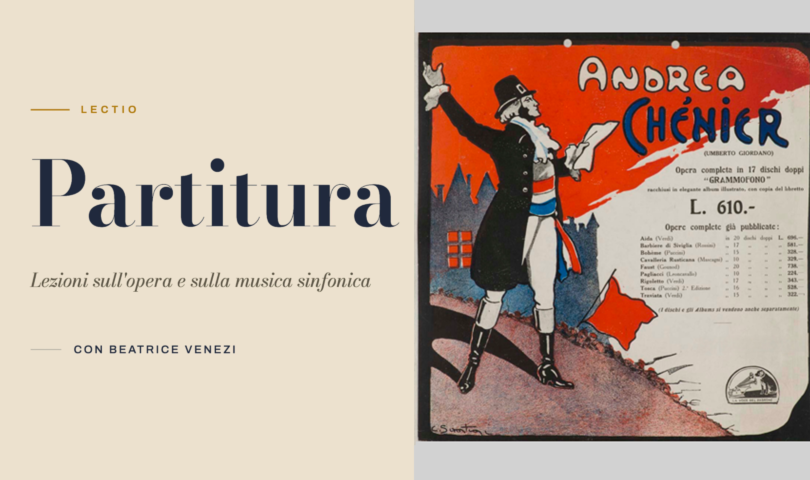
This statement, bitterly reversed, is also the subject of Andrea Chénier's (1896) Umberto Giordano, set in that revolutionary France that transformed a libertarian revolution into a bloody regime.
There are three characters: Maddalena, the daughter of the aristocracy; Andrea Chénier, the poet; Gérard, a servant in the house of the Countess Mother, who has always been in love with Maddalena. You have already learned this: in the work, the loves that are reciprocated are few and always fraught with torment. Maddalena loves Andrea.
Then the revolution sweeps away the French nobility with the guillotine, and the parties turn on each other. Gérard is now one of the leaders of the new regime. And what does he do with that power? He wipes away the tears of the orphans, alleviates the suffering of the poor? No: he uses it to have Andrea, whom he is jealous of, imprisoned and unjustly accused.
To save him, Maddalena – who fell into poverty and was supported by the old servant who prostitutes herself for her – decides to offer herself to Gérard. Her aria, La mamma morta, is of absolute torment: the screenwriters of Philadelphia must have thought about it too, because it is precisely this aria that they used to build the scene between Tom Hanks and Antonio Banderas.
And that's where the interesting thing happens. Gérard is tempted, of course. But something inside him has broken:
«Once it was a joy for me to pass through hatred and vendettas, pure, innocent and strong. Gigante believed in me... I am always a servant! I have become a master. […] The revolution devours its children.»
Gigante believed me. He is always a servant. In two verses there is the entire parable of someone who wanted to change the world and ended up replicating, identically, the power he intended to destroy.
Gérard is moved; he refuses Maddalena’s offer, tries to clear Andrea in the trial. In vain: the poet is convicted. Then Maddalena performs the extreme act: she gives her pass to a mother sentenced to death, takes her place, and goes to the scaffold together with the man she loves.
«Except for a mother! Maddalena at dawn / she has a name for death: Idia Legray!»
And when you get used to living with such relationships, how can you settle for something mediocre?
The fate of ideals is ironic when they are not supported by a concrete, critical look at reality: they end up in the mud. Those who wanted to change everything caused more pain than they intended to avoid; they restored the same cruel power they wanted to destroy. In the streets that had seen the barricades and the fire of ideals, after the riots there will remain only a long trail of terror.
Andrea Chénier then teaches us to be wary of the new, to not listen to the revolution? Absolutely not. He rather shows us the consequences of the one-way thinking: what happens when we decide to settle for what is told to us, without making autonomous decisions. That is exactly what happened to Gérard. He contented himself with only one of the many possible narratives, accepted it uncritically, and in the end lost everything: his idea, his soul, and Maddalena.
Here is the theory of practical criticism that this work delivers to us today. Let us never be satisfied with generalized morals or simplistic narratives when analyzing the present as well as history. Let us not listen to the common prejudice: let us think with our heads. Let us inform ourselves, read, and decide. Let no one brainwash us with preconceived ideas.
Let us make our present become the concrete realm of critical thinking.
Beatrice Venezi