
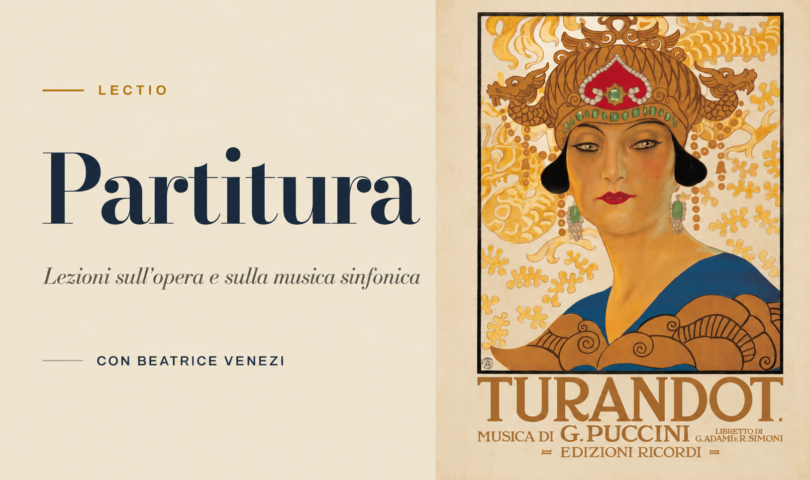
Beatrice Venezi’s BLOG –
I am writing to you from Baku, in the heart of the Caucasus, in that Asia that seems made especially for the climate there. Turandot: a threshold between East and West, where the Caspian wind brings smells and sounds that to an European ear already sound like music from elsewhere. I am here these days to conduct precisely Turandot. It is a work to which I am connected in more ways than just the repertoire: it marked my debut at the Teatro Colón in Buenos Aires, and every time I reopen this score I realize that the questions of the first time are still there, intact, waiting for me. For this reason I feel like talking about it.
A suspended time
«In Beijing, in the time of fairy tales» That is what the caption on the booklet reads. It is not a place or an era, therefore, but a suspension. And it is worth noting a curious circumstance: Turandot it is, along with The Villi, The only fantastic subject that Puccini ever dealt with. The first and last of his works touch on the fantastic, as if the circle of his creative life were to open and close outside of time: a fairy tale setting around a catalog of women, cities, and real destinies.
Now, we know very well how Puccini was a constructor of worlds. For each work, he studied in depth the customs and traditions, traditional instruments, and authentic melodies of the places where he wanted to set his stories, determined to avoid any lapses or inaccuracies. For Turandot He did the same — collections of authentic Chinese melodies, even a carillon by Baron Fassini, his friend, from whom he drew themes that would become unmistakable in the work — but with a decisive difference: his China was not supposed to be real. It was supposed to be a fairy tale China, suspended, dreamlike. And the suspension, in music, is built up.
How? With parallel fourths and fifths: arrangements stripped of the third note, that which tells the ear whether we are in a major or minor key. With that compass removed, the Western listener loses the perception of time and remains, literally, suspended. Then there are the hexatonic and pentatonic scales, foreign to the tonal system that is familiar to us; and an unprecedented weight given to the percussion section, with the addition of xylophones, tubular bells, and Chinese gongs: new timbral solutions, at once bold and refined. Real materials, however, are assembled in a landscape that does not exist. It could be said that the most impressive setting of this work is not on the stage: it is in the orchestra.
A critic of Stampa, the day after the first performance, quite rightly pointed out the point: for the first time Puccini abandoned the linear, discovered, logical drama for a tortuous, mysterious, fantastic action. He had noticed this too, first. And perhaps it is here that the mystery begins.
A shadow of Strauss
Turandot It doesn’t sound like a Puccini opera. It sounds, rather, like a Symbolist opera, and to me, every time I conduct it, it is strongly marked by the shadow of Richard Strauss.
It's not a dream for the podium: Puccini was, of all our composers, the most curious about what was happening elsewhere. In 1906 he traveled halfway across Europe to attend the Austrian premiere of Salome in Graz — in the same room Mahler, Schönberg, Berg sat — and in the years of Turandot He followed closely Debussy, Stravinsky, Schönberg, and Bartók. That world enters the score, and not just as a quote: it enters as a way of thinking about theater.
Take the blotch of the octave that punctuates the entire first act; that small sharp scratch that returns like an obsessive tic: it is a gesture that we know well; we find it, for example, in The DieWoman without shadows. Listen to the first appearance of Turandot, suspended and cruel, all ceremonial and nothing lyrical at all. And above all, listen to the third act, when the masks try to convince Calaf to settle for other women: there the echoes of Salome They seem almost declared. The moon, moreover, presides over both works and most likely reflects the Strauss influence; the moon that the choir invokes in Beijing («Why is the moon late?») and that in Salome It is the fixed eye of the entire tragedy.
But the deepest point of contact, and for me the most revealing, is an interval. Turandot It opens onto a tritone, and on the tritone it builds its own tint. The tritone is the interval that divides the octave into two perfectly equal parts: for this reason it has no gravity, it does not indicate a direction, it does not tell the ear where it is to be placed. The medieval theory called it Diabolus in musica and forbade its use, not (just) for superstition but for a precise technical reason: it is the only interval that denies the tonal hierarchy, that refuses to resolve. A sound without center. Also Salome It opens on a tritone, and the kinship — analyzed analytically — is not random. On this ambiguous axis, Puccini establishes a harmony that scholars define as bicentric: two poles that coexist without ever merging. I find that to be the most accurate musical definition of the entire story. Turandot and Calaf are two centers that do not resolve into each other, and the missed finale is already written there, in the opening bars.
And this is where I would like to be precise about the word “symbolism”, because it risks sounding like a generic label. Symbolism is a well-defined poetics, that of Mallarmé and Maeterlinck, and in theater it entails precise dramatic consequences. First: the character ceases to be a psychological individual and becomes an emblem; not a character that evolves, but a figure that means something. Second: the action becomes rigid in ritual, static theater, ceremony; it does not proceed by cause and effect, but by appearances. Third: at the center there is no desire, there is an obsession, and its object is inaccessible by definition — often a fatal woman who coincides with death. Fourth: fixed, autonomous images return, almost hypnotic: the moon, blood, veil, severed head.
In light of what has been said, please read again. Turandot: the The heads of the contenders impaled on the walls, like the head of the Baptist on Salome’s tray. The moon that regulates the ritual of execution. A protagonist who is not a woman but an enigma, and who appears for the first time without singing a note, mute, like an icon. A choir that moves in a ceremonial mass. A critic has described the passage of this work as cruel, precious, impassive: three adjectives that could apply to Pelléas and Mélisande, the quintessential symbolist work, and it is no coincidence that it is from there, according to Teodoro Celli, that the melody of You who are wrapped in ice.
That is why I say that this work is not Puccinian: it is an aesthetic of ritual and symbol, not of feeling. A work in which the characters matter more for what they represent than for what they feel. It is exactly the opposite of the Puccini we believe we know, and perhaps it is already half the answer to the question that follows.
Two disgusting protagonists
Because the real question, the one that no one has ever really answered, is this: why did Puccini not manage to finish his work?
Attention: It didn't turn out the way it is often told. It wasn't death that interrupted it. Turandot. Puccini had finished and orchestrated every note by the time Liù died months before leaving for Brussels; what stopped him was not time, but something that rather resembles a moment of profound compositional difficulty. Simply put, he couldn’t go on. And I believe that this difficulty had a name, in fact two: Turandot and Calaf.
Both, in fact, are far from the usual Puccini characters. And — let’s face it — both deeply repulsive. On the one hand, the icy princess we all know: cold, ritualistic, ready to bring down heads over a riddle. On the other hand, Calaf, and this is where my reading becomes more radical: Calaf does not fall in love with Turandot. He falls in love with the idea of power. He is a decadent prince, the son of a deposed king; in that inaccessible woman he does not see a person but the reconquest of what was taken from him. And the libretto, if you listen to it properly, says it openly: it are the three masks that shout it to his face, «Turandot does not exist! There is no Nothing in which you dissolve yourself!». Calaf’s object of desire is the Nothing of power and vain glory, and he throws himself into it with enthusiasm: a hero who pursues power disguised as love. It is difficult to imagine anything more distant from Puccini’s human universe — and, on closer inspection, more similar to ours.
Liù, or the humanity necessary
And it is among these two anti-human characters that Puccini is almost forced to create Liù. In the original fairy tale by Count Gozzi — whom Puccini, by the way, did not meet in the Venetian text but through the version by Schiller translated by Andrea Maffei — Liù does not exist. Puccini includes her because otherwise she would have been missing from the story: the Puccini heroine, the woman who loves and sacrifices herself, the ultimate transfiguration of that kind of female character that had been Manon, Mimì, Butterfly. Liù is the only reserve of humanity in history. And for this reason, I believe, when Liù dies everything comes to a standstill and is exhausted: the story comes to a standstill, Puccini’s creativity is exhausted; the entire Italian melodrama ends — one might say — that will no longer be the same after him.
I have always found those last lines moving: the bows that draw a descending line, like the descent towards death, and the octave that rises and remains suspended in the air, like the soul of Liù ascending to heaven. Puccini stopped there. «Not having finished it… it hurts me», He confessed at the end of his life. And to those around him in those last moments he gave precise instructions: «The work will be performed incomplete, and then someone will come out and say to the audience: “At this point the Maestro is dead”. At the premiere of La Scala, on April 25, 1926, Toscanini did exactly that: he stopped at that fateful Mi funebre that coincides with the end of Liù, suspended in the air like a farewell. Puccini, after all, dies along with the heroine of his last work.
The debate about that finale never subsided: Alfano’s complete version, cut by Toscanini by more than a quarter, the version revised by Berio in 2001, and also Gerhard’s claim that the work should be performed only to the point where the Maestro left it. I have written more extensively about this in Puccini against everythingAnd it’s not a question that can be dismissed in a few lines. But one thing I can say as a director: when I can, I always prefer to dwell on the death of Liù. After that funeral procession, everything remains suspended, emotionally engaging, cathartic, both for the performers and the audience, and I think it’s the most honest way to respect, together, the work and its silence.
The choir, or of us
Finally, there is an element that I would like to draw your attention to, because in this work it acquires an importance that Puccini had never granted it before: the choir. Here we return to the Greek conception of the choir as a common moral: it is the community, of course, but it is also a protagonist, indeed, perhaps the true protagonist of the opera.
When she discovers that Liù knows the prince's name, the crowd attacks her violently: «Be bound! Be tormented! Because you speak! Because you die!». And a moment after his death, the same crowd asks her for forgiveness — not for repentance, mind you, but for fear that the offended soul might take revenge. Fierceness first, superstition later; conscience never. It almost seems as if Puccini had seen the wave of collective hatred that is typical of our times, of the civilization of social media: the mob that rages, the mob that absolves itself, the mob that never really looks at the body it has left on the ground.
In the time of fairy tales, that is, now
That is why, from the podium in Baku, this score seems to me anything but a distant fairy tale. A prince in love with power, a crowd that goes from lynching to self-exultation, and in the midst of it only one creature capable of truly loving — which in fact does not survive. «In the time of fairy tales», Says the caption. But fairy tales, we know, always speak of the present. Puccini stopped where the humanity of his story ended; to us, the task is to start again from there.
Beatrice Venezi