
Beatrice Venezi’s Blog –
When the EOLIè Festival asked me to talk about the abyss, mystery and surfaces, for a few days I thought it was too big a topic for me. Then I realised that it’s the very subject I work on every day; it’s just that I’ve never called it that. Because I have a rather unusual job: I spend my life amidst the silences between one note and the next. That’s where it all happens, in those tiny intervals that the audience doesn’t even hear — that’s where it’s decided whether a phrase breathes or breaks, whether the sound opens up or closes. By the nature of my work, I stand on the edge of something. And an edge, by definition, is the point where a surface ends and a depth begins.
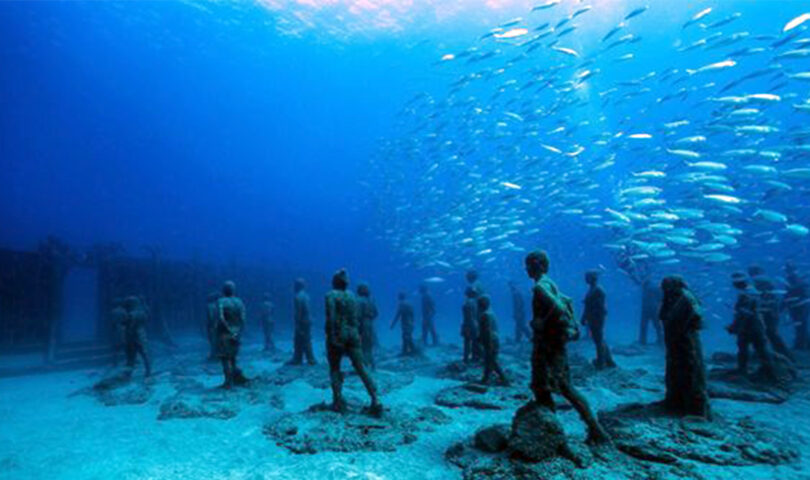
There couldn’t be a more fitting place than this to talk about it. The Aeolian Islands are made up of precisely this: volcanoes that are raging fire beneath and rock upon which we walk peacefully above; a sea that reflects the light on the surface and grows dark just a little deeper down, and none of us really knows where the seabed ends. These islands are a living metaphor. They are both surface and abyss, held one above the other, and the fact that life continues up here, serene, with its white houses and boats, does not in any way erase the fire that lies beneath. If anything, it forgets it. It is different.
And it is precisely from this word — to forget — that I want to leave.
These days, we’re in the habit of forgetting the depth, to ignore it. We get on just fine on the surface. In fact, we’ve become extraordinarily good at staying there. We have learnt to present the best side of ourselves, and to see in others only the side they choose to show us. We glide through our days from one image to the next with an ease that no generation before ours has ever possessed. And let’s be clear: this is no fault of ours; the surface is convenient, it’s quick, it protects us. The problem isn’t that we live on the surface. The problem is that, by dint of staying there, we’ve begun to believe that there’s nothing beneath it. That the surface is everything. That depth is optional – indeed, a complication.
However, the depth does not go away. It keeps calling, softly, like a sound coming from another room. We hear it in the most unexpected moments — at night, whilst mourning, gazing out at the sea, when a piece of music catches us off guard and moves us without us being able to explain why. In those moments we realise that the depth is there, it has always been there, and we’re not quite sure what to make of it. We’d like to cling to something that lasts, and yet at the very same moment we’re frightened by the idea of tying ourselves down, of staying put, of sinking. We want depth and yet we’re afraid of it. It’s a contradiction we carry with us like a second skin.
There you go. To understand this contradiction — which is ours, but did not originate with us — we must go back two centuries, to an era which, faced with the abyss, took the exact opposite gamble to ours. It did not flee. It plunged straight into it. And it did so with a seriousness that almost embarrasses us today.
You don’t need to know anything music to keep me company. Actually, it’s better this way. Let’s start from scratch.
There was a time, in Germany, between the late 18th and early 19th centuries, when a group of poets, musicians and philosophers came to a revolutionary conclusion: that the truth of a human being lies not in what they reveal, but in what they conceal. They called it Romanticism — a word we now associate with bouquets of flowers and candlelit dinners, but which back then meant something far more dizzying. It meant believing that within each of us there was a bottomless well, and that the task of art — of all art — was to descend into that well and bring something back up.
The Romantics loved the night more than the day. Not because they were melancholic by nature, but because at night the surface of things fades away: sharp outlines, colours and reassuring distances vanish, and only depth, the unspoken and the infinite remain. One of them, the poet Novalis, wrote *Hymns to the Night*, in which darkness is not a lack of light, but the place where one finally sees what light conceals. They even had a word for that aching longing for something one does not possess and perhaps never will: *Sehnsucht*. A longing directed not towards the past but towards infinity. The call from the depths, in short — the very same call that we still feel today and do not know how to respond to.
This is where the music comes in, and with it the philosophical thought of those years. Because the Romantics made a discovery that concerns us all, even those who have never opened a sheet of music in their lives. They realised that, of all the arts, there is only one that does not describe the world. Painting depicts it, poetry tells its story, sculpture imitates it: all of them, in a sense, exist on the surface of the world, reflecting it. All except one. Music represents nothing. It does not tell you “this is a tree”, “this is a battle”, “this is a sunset”. Music does not describe the world: it is its inner voice. The philosopher who understood this better than anyone else expressed it with an image that, on its own, is worth my entire talk this evening: “Music is the melody to which the whole world is merely the lyrics”. You know how, beneath a melody, the words of a song flow? Well, for that philosopher, Schopenhauer, the whole of reality — things, events, people — is merely the text written beneath a melody that already existed before, and which is music.
Take a moment to think about this idea, because it is immense. It means that music does not remain on the surface alongside the other arts. Music is the only thing that descends directly to the depths, that speaks the language of the abyss without resorting to words, without resorting to reason. That is why a melody can make you cry without explaining why, even before you realise what is happening to you. It doesn’t knock on the door of your mind. It enters through the cellar. Music is living proof that the abyss exists, because it touches it every time it plays.
It’s just that — and the romantics found this out the hard way — Those who truly gaze into the abyss sometimes fall into it. Reaching the depths takes its toll. They even coined a word for this price, a beautiful and terrible German word: Zerrissenheit. It is difficult to translate. It means laceration, an inner tear, the soul torn to pieces. Not a passing disturbance: a condition, almost a fate. The poet Heine put it in the most stark terms I know, writing that the great fracture of the world – Weltriß – runs right through the heart of the poet. Do you understand what that means? It means that those who choose the depths do not choose peace. They choose to feel the crack in the world opening up within themselves.
But let’s leave the philosophers aside for now, because all of this — the abyss, the voice from the depths, the inner turmoil — did not remain an abstract idea. There was a man in whom it became flesh, life, biography. A man who experienced Zerrissenheit to the very end, and who was, in the end, consumed by it. His name was Robert Schumann.
Let me tell you about it the way a person would tell a story, not as a composer explains it, because that is how it should be understood.
Schumann had two professions. He was a musician, of course. But he was He was also a critic, someone who wrote about music — not just to make ends meet, but to fight a battle. He had founded a magazine of his own, the Neue Zeitschrift für Musik, the “New Music Journal”, and from there he waged war against what he considered the true enemy of art: mediocrity. Music made merely for pleasure, to fill drawing rooms, so as not to disturb anyone. Superficial music, as we might say tonight. He had even imagined a secret brotherhood of rebellious artists fighting this battle — he called it the “League of David”, David’s companions against the Philistines. To him, the Philistines were all those who were content with the surface of things and were afraid of what lay beneath.
Here’s the detail you absolutely must know:, because without it, one cannot understand who this man was. When Schumann wrote for his magazine, he almost never signed with his own name. He signed using fictional characters. He had invented imaginary figures, and each one was a part of him. The first was called Florestano: impetuous, passionate, in love with everything new and daring, a man who throws himself into things. The second was called Eusebio: a dreamer, gentle, thoughtful, melancholic, a man who takes things more slowly but goes deeper, and who stays. Two opposing voices within the same man. And you know what? They weren’t enough for him. He invented a third, and this is the most moving of them all: Maestro Raro. A wise, mature, balanced man, whose sole task was to hold the other two together. To act as a bridge between fire and night. To mediate. To bring together within a single individual — a “rare” individual, indeed — two forces that, on their own, would tear each other apart.
Think about it. A man who, to tell the truth about himself, needs three voices. It was no literary game. It was the map of a soul that could not be a single entity, and knew it. And those three did not live solely on the pages of the magazine: Schumann also concealed them within his own music, as the secret authors of his own notes.
Beneath these three characters, however, There was an even deeper and more painful rift: a man torn between prosaic middle-class necessities and poetic fervour. On the one hand was the man who longed for a normal, stable, respectable and secure life — a good marriage, a position of status, the world’s approval. On the other was the artist who wanted to devote himself to art body and soul, with no safety net, to the very end, whatever the cost. Florestano and Eusebio were merely the gentle names given to this rift. And that rift was so deep that, over the years, it became a genuine mental illness. Because Schumann’s inner turmoil was not an act, as I told you. It was real.
And then, at a certain point, the abyss, What had for years been the place to go in search of the truest music ceased to give him that. He began to hear sounds that weren’t there. He tried to take his own life. And he spent his final years in a care home, far away from everything, whilst his mind gradually slipped away from him. Sometimes, the abyss does not bring you back up. It is the price the Romantics spoke of, paid in full.
I’ll leave you with one last image of Schumann, and it is the most precise of all, the one in which this argument converges on a single point. There is a piano piece of his called *Humoreske*, Op. 20, dating from 1839. At one point in that score, Schumann writes a melody that is not played. On the page there are three staves: the right hand at the top, the left hand at the bottom, and in the middle a third line which he titles “inner voice” — innere Stimme. That middle line is written note by note, with care, and yet no one plays it. It cannot be heard with the ears. It should only be felt within: it arises from the interweaving of the two playing hands, it lives in the silence between them; it is a melody that exists but cannot be heard. Schumann has written, in black and white, the abyss. He set on the stave the proof that the most important thing can exist even when you do not play it.
This, you see, is That is precisely the depth we are talking about tonight. It doesn’t stop resonating just because we’ve decided not to play it. It’s there, between the lines, in our hands, beneath the surface of the notes we can actually hear. That’s how the inner voice within each of us works.
From inner turmoil From one man, we move on to the most disruptive rift that has ever occurred in the history of Western music.
Western music For centuries, it has been based on a central pillar: the so-called tonal system. I won’t go into the technical details, but just think of any piece of music you know and reflect on this: however far it strays, in the end the music always “comes home”, returning to a resting chord, and that return is the sense of peace you feel when a piece ends. It is the solid ground. It is the solid, reassuring foundation of music.
Right. There is a moment in history, where the mainland splits apart. And it is a single chord. It is the chord that opens Richard Wagner’s Tristan und Isolde. A chord that does not return home. That does not rest. That remains suspended, in tension, yearning, and does not resolve, like that profound and insatiable force of which Schopenhauer spoke. In the history of music, that chord is a gash, a tear, a wound that has never healed: the first crack in the seemingly solid walls of harmony. And from that crack, in the decades that followed, ever deeper fissures opened up, until music renounced any return home altogether, giving rise to the avant-garde movements of the twentieth century that would reject the tonal system entirely.
Just one agreement. And within that surface, all of a sudden, you glimpse the abyss. It isn’t described: it is made to be felt. Wagner doesn’t tell you that there is a restless depth beneath things. He makes you feel it in your very body, in five seconds, even before the curtain rises.
At this point, someone might say to me: So what? If the abyss comes at such a high price — if it sends Schumann to a care home and even undermines the very foundations of music — is our age not right to choose the surface? To stay afloat, prudently, without looking beneath?
In my view, however, the question is a different one: Do we want to stay on the surface so as not to see the depths, or to remain light whilst carrying the depths with us? True lightness does not shy away from depth. It knows how to bear it without being crushed by it. It is the difference between those who float because they are afraid of the water and those who swim because they know the water. It is the lightness, in the spirit of Calvin, of gliding down from above upon things.
So the question is: Which surface? The one that conceals the void, or the one that holds a depth?
To reply I want to take you forward a century, and show you the image with which I shall conclude.
There was a man, in the 20th century, who held down two jobs at the same time, just like Schumann. He was a composer, but he was also an architect, and he worked alongside one of the greatest architects of the century, Le Corbusier. His name was Iannis Xenakis, and he is one of the leading figures of the twentieth-century avant-garde. He is the man who brought mathematics into the orchestra: he invented what we call stochastic music — a complicated word for an idea that is, at heart, crystal clear. Instead of writing note by note, Xenakis governs entire masses of sound using the laws of probability, just as a physicist calculates the movement of a crowd, a flock or a swarm. And this sums up our entire argument: what reaches our ears — a cloud of sound that thickens and thins — is merely the audible manifestation of a profound law that holds it together from within.
At one point, he wrote a piece entitled *Metastaseis*, consisting almost entirely of gliding sounds — notes that rise and fall slowly, like sirens, like winds, like tides. If you take those gliding movements and draw them on a sheet of paper, the intersecting lines do not form just any old pattern: they form curved, taut, beautiful surfaces. And those surfaces, born of music, became a real, standing, habitable building: the Philips Pavilion at the 1958 Brussels World Fair. Music that became architecture. A sound that became a roof over people’s heads.
Do you understand what Xenakis did? He has demonstrated something that overturns all our fears. For him, a surface is never merely a surface. It is the visible face of a deep structure: of a law, of mathematics, of a hidden force that underpins it. In Xenakis’s work, the surface and the depths are not enemies. The surface is the depths brought to light. It is the abyss that has agreed to take on a form, so that it may be seen, touched, traversed and shared.
Here is the answer. The surface is not the opposite of the abyss. The surface, when it is genuine, is the form the abyss takes in order to become habitable.
So, back to the matter at hand, because people are talking about us, and that contradiction we started with. We want depth, yet we are afraid of it. We want to form bonds, yet we fear that those bonds might become a cage. We want to be seen for who we really are, yet at the same time we do everything we can to ensure that no one ever really gets that deep.
Are we really that different from Schumann, Why did it need three names to describe a single person? Or have we simply, unlike it, lost the courage to put that inner voice into words — and do we merely pretend it doesn’t exist? Are we truly afraid of depth, or are we afraid of being caught out when we actually possess some? Do we want lasting bonds, or merely the reassurance that we’ll never have to delve deeply into anyone? And when a piece of music, a night, or the sea briefly reveals the crack beneath our feet — do we look at it, or do we rush straight to close it up with the first image that comes to hand?
I don’t have an answer that will sort all this out, and I am wary of anyone who possesses it. Indeed, I am convinced that this contradiction should not be resolved at all. Schumann did not heal his own fracture: he composed it. He transformed it into music by bringing his two – or rather, his three – elements together. Xenakis did not choose between sound and space, between the depth of calculation and the surface of form: he made them one and the same. And these islands, beneath us, do not choose between fire and rock: they keep the fire below, and allow us to walk upon them. Life, music, and perhaps even love, are never found in the answer. They lie in the tension between the two.
You don’t have to jump into the crater to prove that the fire is real. You don’t have to tear yourself apart like Schumann to prove you have a deep soul. The inner voice doesn’t need to be played out to be true. The abyss doesn’t need us to leap into it to be honoured. It takes far less than that, and yet it is the hardest thing of all: all you need to do is stop pretending that there is nothing beneath. Let it ring out, that underlying sound, subdued yet constant, beneath everything we show — like that melody Schumann wrote but never had performed, and which is nonetheless the truest thing on the page.
Abyss and Mystery. Come to think of it, on these islands, I feel as though I’m exactly where I should be.
Beatrice Venezi